For years, the default playbook for luxury brands entering gaming has been to find the biggest title, attach a logo, and call it a partnership. Porsche just did something far more considered.
Their collaboration with Riot Games inside League of Legends: Wild Rift is not a logo drop. It is a studied move into a specific community, built around genuine audience fit, and executed with enough creative depth to feel like it belonged there from the start.
This is what a brand activation looks like when it starts with the data instead of the hype.
What Porsche and Riot Games Built Together
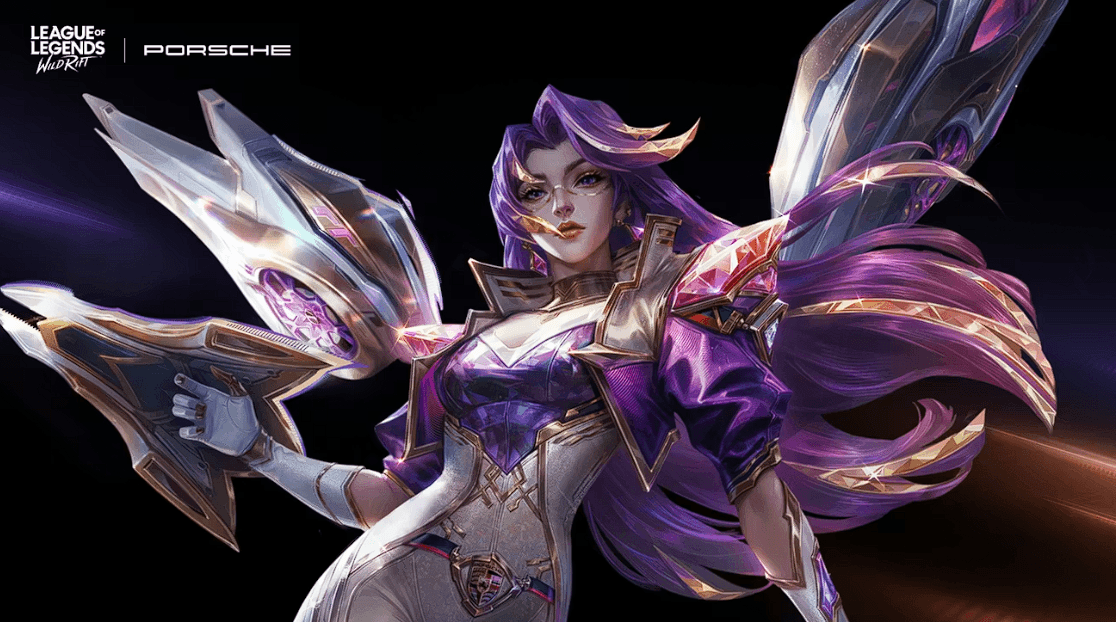
At the centre of the collaboration is Prestige Select Neon Daredevil Kai'Sa, a new champion skin for one of Wild Rift's most played characters, inspired by the Porsche 911 GT3. The skin is exclusive to Wild Rift, the mobile-native version of League of Legends built specifically for a 5v5 touchscreen audience. It does not appear in the PC version of the game. That distinction matters, and we will come back to it.
Alongside the in-game content, Porsche and Riot Games built a one-off real-world 911 GT3 with a bespoke livery that directly references the Kai'Sa skin's colours and graphic patterns. The car will appear at fan events including activations at Porsche Experience Centers in Los Angeles and Shanghai, giving the collaboration a physical presence that mirrors its digital one. The Neon Daredevil event runs from April 30 to May 28, 2026.
Why Kai'Sa, and Why It Works
The choice of Kai'Sa as the vehicle for this collaboration was not aesthetic convenience. Kai'Sa's playstyle maps directly onto the core performance traits of the 911 GT3: acceleration, precision, adaptive targeting, and decisive overtaking. Her abilities mirror the language of motorsport in a way that feels inherent rather than constructed.
This is the mechanism that separates credible brand integration from costume-party sponsorship. When the character's identity and the brand's identity share the same underlying logic, the community does not need to be persuaded. The fit speaks for itself.
The surrounding Neon Daredevil update extends that logic across the full event: racing-inspired cosmetics for six additional champions, a collectible companion called Hyperspeed Cloudchaser referencing the horse at the centre of the Porsche crest, and a racing-themed visual refresh across the game experience. The brand is not a guest. It is woven into the event's internal language.
The Audience Fit That Made This Inevitable
What makes the Wild Rift choice strategically sharp is what the data reveals about who actually plays it.
According to GWI, regular Wild Rift players are three times more likely to be high net worth individuals compared to other gamers. Gamers who follow the Wild Rift franchise are 33% more likely to consider Porsche in their next vehicle purchase than other gamers. These are not correlations that happened by accident. They reflect a community built around mastery, competition, and aspiration, traits that sit comfortably alongside Porsche's brand DNA.
Our Signal tool at Mana Partners found something even more structurally interesting: Porsche and Wild Rift audiences share an identical digital behavioral blueprint. Both discover content through high-volume TikTok, then anchor their deepest engagement in high-skill, competitive Twitch communities. For Porsche, that community is built around sim-racing titles like iRacing and Assetto Corsa. For Wild Rift, it is the MOBA esports ecosystem anchored by r/wildrift. Different worlds, same architecture.
This is also a genuinely global activation, running simultaneously across Western markets and China. For a title that has historically been marketed in regional silos, that geographic commitment signals how seriously both parties are treating this moment.
The Broader Implication for Brands With Sports Equity
Porsche did not enter gaming through the door that was most obvious to them, sim-racing, where their audience already lives. They entered through a door that required them to understand a different community on its own terms, and to build something that community would recognise as native rather than transactional.
That is the more interesting move. And it is replicable.
There is a generation of brands with deep sports equity but no meaningful gaming presence. They see gaming as a media channel rather than a cultural territory. The Porsche x Wild Rift activation is a direct argument against that framing. Gaming audiences are not monolithic. Wild Rift's players are not the same as Valorant's players, or Clash of Clans players, or Call of Duty players. Each community has its own behavioral fingerprint. The brands that find where they already belong inside that landscape, rather than simply buying space inside it, are the ones that build something lasting.
That is how you earn relevance in gaming. Not by showing up loudest. By showing up right.
If you are a brand looking to integrate into gaming and esports in a way that builds relevance and long-term impact, Mana Partners helps you make lore, not noise.
Author

Seif Seoudy
We build brands that speak the language of gamers. Authentic, electrifying, unforgettable.


