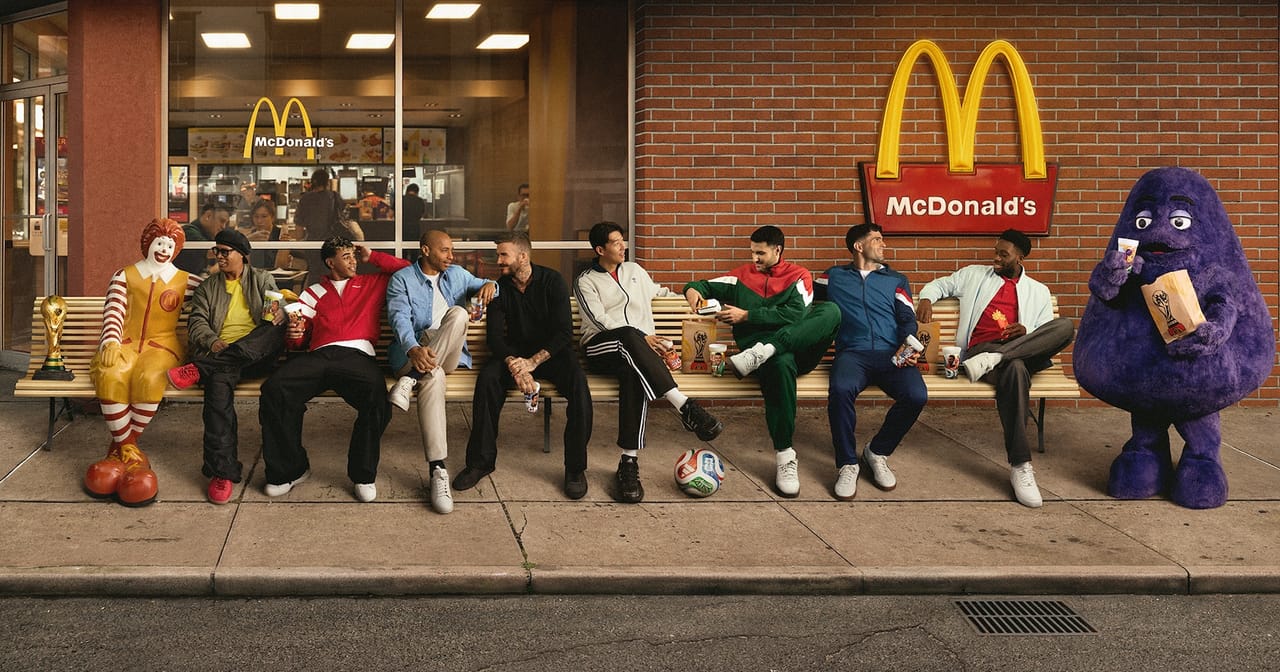
The world's biggest sporting event is also the world's biggest fast food moment. That is not a coincidence. McDonald's has spent years building a customer base that over-indexes heavily on football culture, and the 2026 FIFA World Cup campaign is the clearest expression yet of a brand that understands exactly who it is talking to.
According to GWI, 82% of McDonald's weekly customers are football fans, and 40% are active World Cup followers. When a brand has audience data that precise, the question is no longer whether to activate. The question is how deep, how wide, and how locally relevant the activation can be.
What McDonald's Actually Built
For the 2026 World Cup, McDonald's launched a multi-layered campaign anchored by three global ambassadors: David Beckham, Ronaldinho, and Lamine Yamal. Each was paired with a dedicated meal, collectible cups tied to the tournament, and a supporting creative programme rolled out across markets. The campaign spans digital content, in-store activation, and organic cultural conversation, operating simultaneously on YouTube, TikTok, and Twitch depending on market and audience.
On the surface, it looks like a straightforward celebrity-led sponsorship. Underneath, it is considerably more engineered than that.
Why the Strategy Is Smarter Than It Looks
According to Signal, our cultural intelligence tool at Mana Partners, each ambassador is doing a different job across different platforms and regions. Beckham drives high-intensity but short-burst engagement on TikTok in the UK, where nostalgia for a domestic football icon is still commercially potent. Lamine Yamal, fresh off a breakout Euro 2024 tournament, is generating broad, stable viewership on YouTube across France and Germany, markets where his profile is rapidly ascending. Ronaldinho, meanwhile, is pulling unexpected numbers on Twitch in Brazil, tapping into a gaming-adjacent youth audience that most food brands would not even think to target.
The localization logic here is not cosmetic. It reflects a genuine understanding that ambassador equity is not transferable across markets. A Beckham campaign running in Brazil would not perform. A Ronaldinho campaign in the UK would fall flat. McDonald's avoided the trap that catches most global sponsors: assuming that global fame produces global relevance.
The other thing worth examining is the meme layer. Signal data shows that the Grimace World Cup trend on TikTok eclipsed official campaign content in terms of organic reach, driven almost entirely by Gen Z fan culture. McDonald's did not create the meme. But the brand's cultural presence was permissive enough for it to happen, and the creative team was smart enough not to suppress it. Official long-form assets on YouTube and meme-ready character hooks on TikTok are running as parallel strategies, not competing ones.
The Physical Layer That Most Brands Miss
The campaign does not live entirely on screens. Collectible cups tied to the tournament are generating significant anticipation in South America, and watch-party meal bundles are proving to be durable cultural touchpoints with staying power well beyond individual match days. Signal data shows the "World Cup watch party food" conversation has low content decay, meaning it sustains engagement across the full tournament window, not just during high-profile fixtures.
This is the part of the McDonald's playbook that is most underestimated. The ritual of eating McDonald's during a match is not a product of this campaign. It predates it. What the campaign does is amplify and legitimize a behavior that already exists in the culture. When the physical and the digital are this well-aligned, the activation becomes self-sustaining.
The brands that outperform their competitors during major tournaments are rarely the ones with the biggest ambassador contracts. They are the ones that engineer a full ecosystem: the hero creative to build prestige, the meme-ready hooks to drive organic reach, and the tangible product ritual to convert cultural relevance into commercial return.
McDonald's, for this World Cup, has built all three.
If you are a brand looking to activate around sport, culture, or entertainment in a way that goes beyond the obvious sponsorship play, Mana Partners helps you make lore, not noise.
Author

Seif Seoudy
We build brands that speak the language of gamers. Authentic, electrifying, unforgettable.