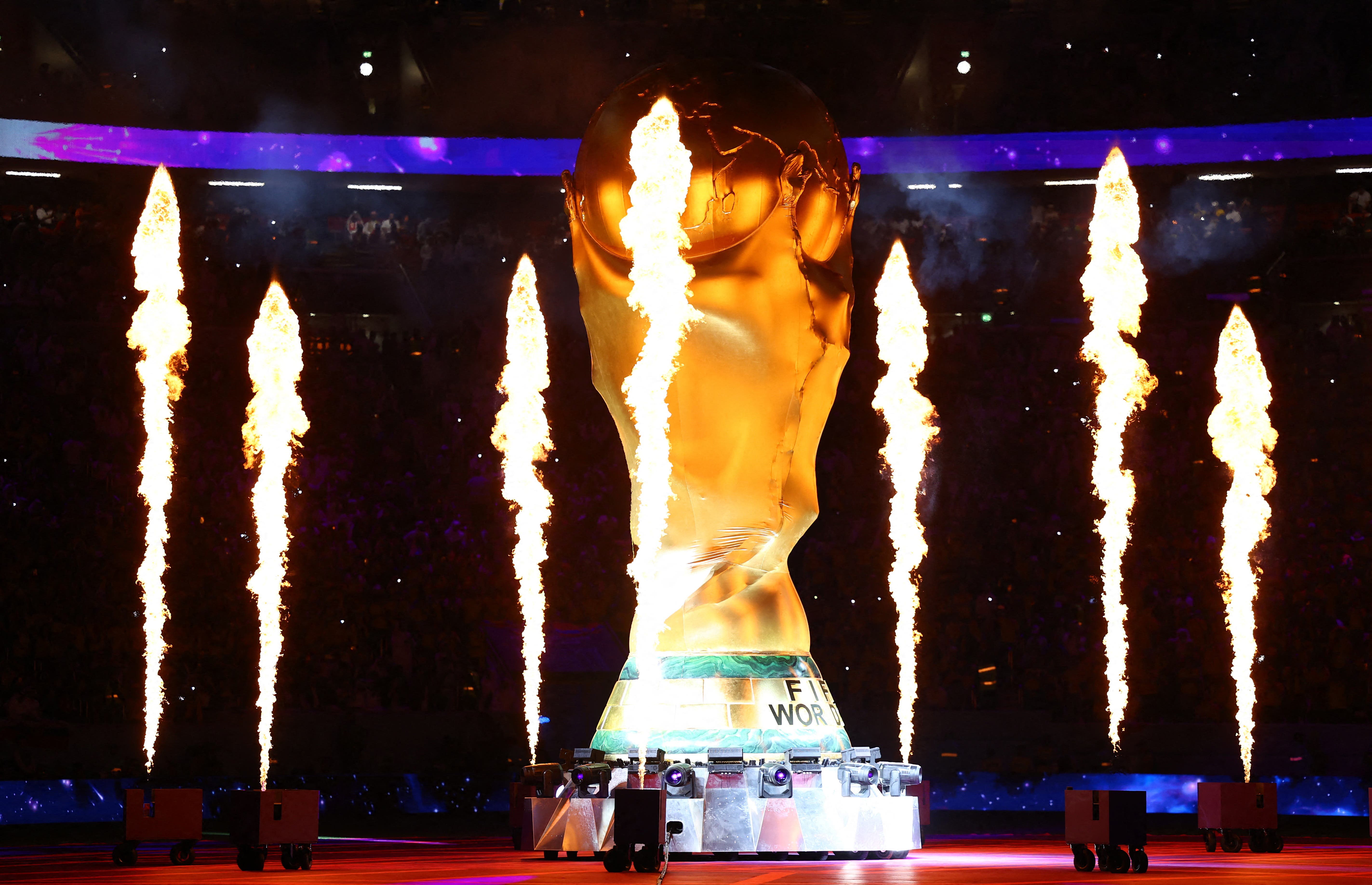
For decades, the Super Bowl halftime show has been as culturally significant as the game itself. Brands built activation calendars around it. Agencies pitched for it. The performance became a media property in its own right. Football, the global version, never had an equivalent. Until now.
FIFA just announced that BTS, Shakira, and Madonna will co-headline the first-ever halftime show at a World Cup final, taking place July 19 at MetLife Stadium in New Jersey. Curated by Coldplay's Chris Martin and produced in partnership with Global Citizen, the show is tied to the FIFA Global Citizen Education Fund, which is working to raise $100 million to expand access to education and football for children worldwide. More than $30 million has already been raised, with $1 from every tournament ticket going directly to the fund.
The announcement is a signal. FIFA isn't just adding entertainment to a football match. It is constructing a new cultural format, one that treats the World Cup final as a global media moment with the same infrastructure as the Super Bowl. For brands already in and around the tournament, the implications are immediate. For those sitting on the outside wondering whether football is the right vehicle for cultural engagement, this should accelerate the conversation.
Three artists. Three completely different jobs.
The instinct when looking at this lineup is to treat it as a single activation. It isn't. BTS, Shakira, and Madonna represent three distinct audience profiles, three platform ecosystems, and three different timelines of relevance.
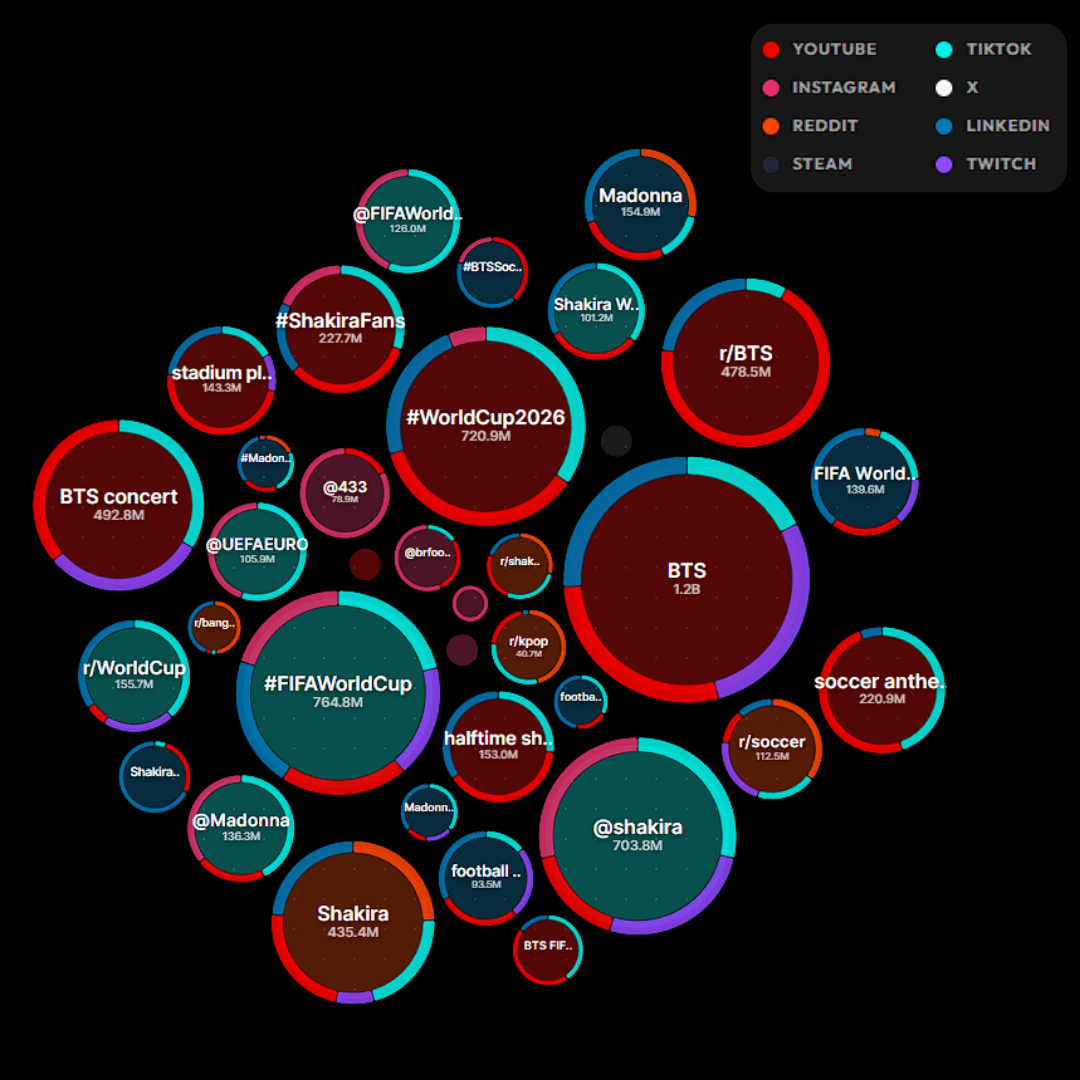
Using Signal, our cultural intelligence tool at Mana Partners, we mapped how FIFA's global football audiences overlap with each artist's fanbase across digital platforms. Shakira is the evergreen bridge. Her 2014 World Cup content, specifically "Waka Waka" and "La La La," still performs at an exceptional level today, with almost no decay. In markets like Brazil, those tracks aren't just songs, they are embedded in the cultural memory of football itself. Shakira doesn't drive a spike. She maintains a permanent baseline.
BTS operates on a different frequency. Their World Cup-adjacent content generates intense engagement, but it decays quickly once the cultural moment passes. That isn't a weakness; it's a function. BTS is the engine for immediate, youth-led activation in the window immediately surrounding the event. Their comeback this year, including the debut of their album ARIRANG and a global stadium tour spanning over 70 dates, means they arrive at this moment at peak cultural velocity.
Madonna sits in a third position entirely. A confirmed Super Bowl headliner, a pop institution across four decades, she carries gravity with audiences that neither BTS nor Shakira directly reaches. Her upcoming album Confessions II, releasing shortly before the final, adds a commercial dimension to her World Cup moment that brands with longer-horizon campaigns can meaningfully attach to.
Signal also clarified where these audiences actually live online. Both FIFA football audiences and Shakira's fanbase find their strongest engagement on TikTok, making it the dominant platform for music-football crossover content and audio trend activation. BTS commands absolute volume on YouTube, which captures longer-form and live-performance consumption. These are not interchangeable platforms, and any brand treating them as such will misread the opportunity.
The geography matters as much as the platform
Football and pop music have always intersected, but not uniformly. In Latin America, that intersection is foundational. In Brazil specifically, Shakira's World Cup anthems are part of the social fabric of how football is consumed and celebrated. In Germany, Signal data shows a purist football culture with low appetite for commercial pop crossovers, where traditional fan chants significantly outperform music-integrated content.
For brands activating around the 2026 final, geographic localisation isn't optional. An Americas-facing strategy built around music and emotion will land very differently from a Western Europe approach that needs to feel native to football culture first, with music as a secondary layer.
What this means going forward
The first-ever World Cup halftime show doesn't just create a new entertainment moment. It creates a new sponsorship category. Brands that understand how to navigate the distinct audience profiles of BTS, Shakira, and Madonna, across the right platforms and the right geographies, have a significant advantage. Those that treat this as a single, undifferentiated cultural event will spend budget reaching audiences they aren't actually speaking to.
The Super Bowl took years to become what it is. FIFA is attempting to compress that timeline into a single event. The infrastructure is there. The artists are right. The question for every brand around this tournament is whether their activation strategy is as sophisticated as the stage FIFA just built.
If you are a brand looking to integrate into global sports culture and music-driven fandom in a way that builds real relevance and long-term impact, Mana Partners helps you make lore, not noise.
Author

Seif Seoudy
We build brands that speak the language of gamers. Authentic, electrifying, unforgettable.


