The FIFA World Cup 2026 is not just a football tournament. It is one of the most concentrated moments of collective human attention on the planet, and brands across every category are competing to embed themselves inside it. Most will buy media. A few will build something worth remembering.
Wolt, DoorDash and Deliveroo have chosen the latter.
The Campaign
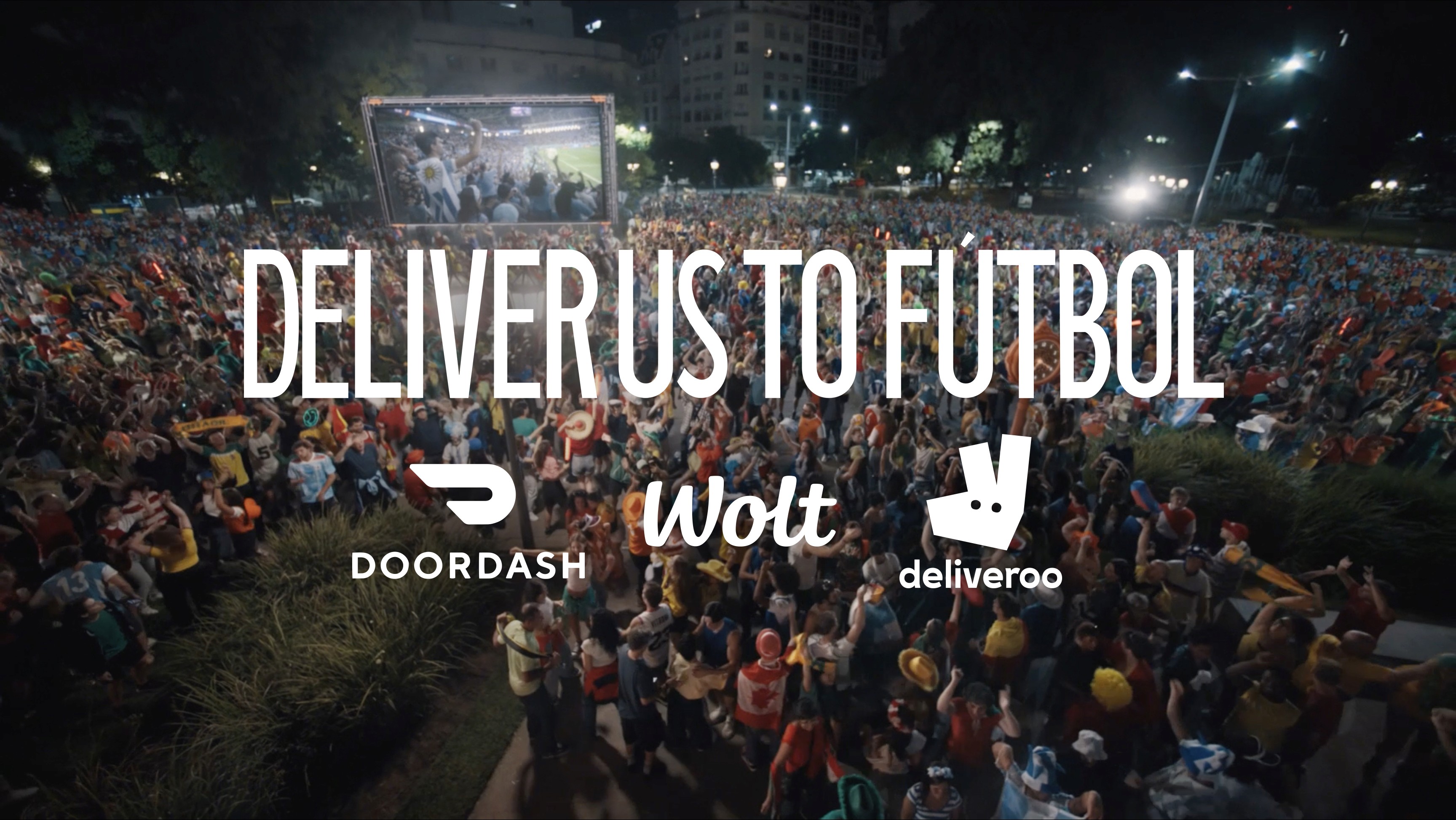
In May 2026, Wolt, together with DoorDash and Deliveroo, unveiled "Deliver Us To Fútbol": their first-ever international campaign and a milestone moment for all three brands. For Wolt, the campaign rolls out across Germany, Norway, Finland and Denmark, running across CTV, paid digital, radio, social, and local activations. It features FIFA World Cup champion Ricardo Kaká, FIFA Women's World Cup champion Alex Morgan, and global creator Khaby Lame.
The campaign follows a courier partner through the emotional arc of the tournament, delivering coffee for late-night matches, a pen for a once-in-a-lifetime autograph, a celebratory meal after a win. As Marianne Vikkula, Head of Wolt, put it: "The World Cup is about connection, a shared experience that brings friends and families together across homes, cities and countries."
The delivery mechanic is how they make that easier.
Why This Works
The strategic foundation here is not sponsorship. It is behavioural alignment.
According to GWI, 32% of FIFA World Cup fans already order meals via food delivery apps. They are 43% more likely to do so than the average person. This is not an audience that needs to be converted. It is an audience that is already primed. The campaign does not try to manufacture a new habit around the World Cup. It simply shows up inside one that already exists.
Signal, our cultural intelligence tool at Mana Partners, reinforces exactly why the timing matters. Search entities like "DoorDash World Cup" and "Uber Eats World Cup" are already accelerating in the 30-day window leading into the tournament, with combined early visibility across brand-specific World Cup queries exceeding 700,000 views. The audience is not waiting for the final whistle to engage. Intent is forming now.
Signal also flags a broader cultural shift worth paying attention to: late-night impulse ordering is declining in momentum, while occasion-based hashtags like #matchdayfood and #WorldCupFood are actively accelerating. The consumer mindset is moving away from convenience ordering toward planned, communal, event-based eating. Watch-party food has become a ritual. "Deliver Us To Fútbol" is built for exactly that occasion.
The Bigger Signal for Brands
What makes this campaign strategically interesting is not the celebrity casting or the production quality. It is the decision to treat matchday as an ongoing cultural behaviour rather than a one-off campaign window.
Signal data shows that hashtags like #matchdayfood and #takeawaynight carry exceptionally high content durability, meaning audiences consume this content year-round, long after any specific tournament has ended. World Cup-specific content, by contrast, decays rapidly once the final is played. The brands that come out of this tournament with lasting equity will be the ones that used the World Cup as an accelerant for a matchday identity they intend to own permanently.
Wolt, DoorDash and Deliveroo appear to understand this. The campaign is anchored in the ritual, not the tournament.
For any brand evaluating a World Cup activation strategy, that distinction is the most important question to answer before committing budget: are you buying into a moment, or building into a behaviour?
The ones buying into a moment will see a spike. The ones building into a behaviour will still be relevant when the 2030 draw is announced.
If you are a brand looking to integrate into live sports and cultural moments in a way that builds long-term relevance rather than short-term visibility, Mana Partners helps you make lore, not noise.
Author