
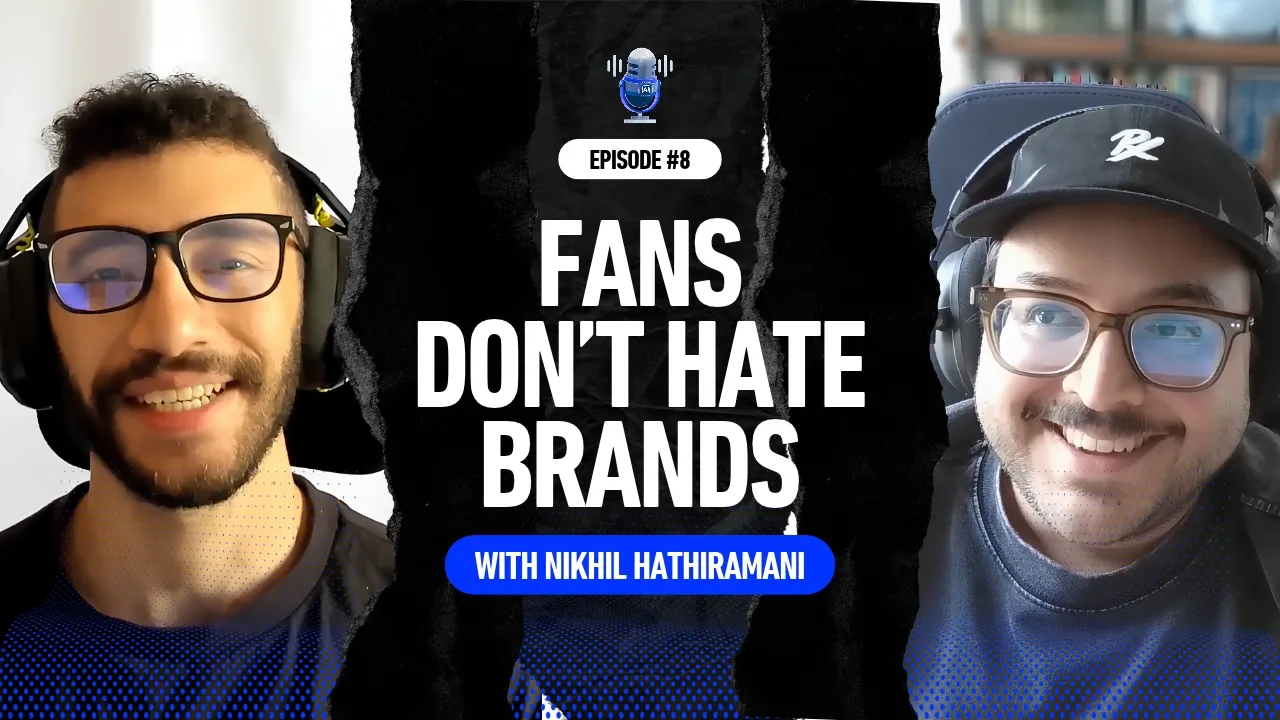
Esports sponsorship works when fans adopt the brand as part of the game, and few people see that line as clearly as Nikhil Hathiramani, Co-Founder and CEO of Paper Rex. In the latest Mana Partners Culture Pulse episode, hosted by Seif Seoudy, Nikhil explains what separates a gaming partnership that gets seen from one that gets remembered, and what CMOs should ask before putting budget behind a game, a team or a player.
His vantage point is unusual. Nikhil started in 2015 with CSGO to Asia, a Counter-Strike news site built to fill an information gap in the APAC region. He spent five and a half years balancing it with the family business before leaving in 2019, and in 2020 he co-founded Paper Rex, under Impulse Entertainment, with Matthew, Harley and Gad. The organisation began in Counter-Strike, moved into Valorant at launch, and has since qualified for 13 of 14 international events. Along the way Nikhil has worked as a journalist, player, coach, caster and streamer, which means he reads a sponsorship deck the way an operator does, not the way an observer does.
Watch the full Culture Pulse conversation with Nikhil Hathiramani on esports sponsorship and brand partnerships.
Start With the Problem Your Brand Is Solving
Nikhil's first filter is clarity of goal. A brand chasing awareness needs a different programme from one chasing product sales or landing page traffic, and the wrong metric can make a good partnership look like a failure. His cautionary example is the Fortnite wave, when many CMOs leaned in because a world champion made headlines, without asking whether the game mattered to their own demographic in their own market. Trending globally does not mean relevant locally.
The same logic applies between games. Everyone is a gamer, from Candy Crush to Nintendo, but every title carries its own community. Counter-Strike players who have stayed loyal for 20 years are a different audience from the Gen Z, more evenly split Valorant base. Brands that treat gaming as one audience miss the integration points that make a gaming partnership feel native.
Why Long-Term Esports Partnerships Beat One-Off Campaigns
The strongest examples Nikhil cites share one trait: time. ESL and DHL have partnered in Counter-Strike across multiple years. DHL does not lack awareness, so the work goes into affinity, turning logistics into memes and skits about delivering the trophy on time or getting teams and staff to the tournament. It only works because the people behind it clearly know the community's language.
McDonald's took a similar route in Scandinavia. Nikhil recalled a burger named after a team in Sweden, and campaigns in Denmark that borrowed the game's own vocabulary, including a value meal called the eco buy. Fans shared it across the Counter-Strike community with no giveaway attached, which he treats as the clearest sign of success. Arby's did the equivalent at an eLeague Major, running custom ads built around the game's sounds for the length of the event.
Naming the Moment: Mastercard Thrifty and Red Bull Clutch
The best current examples sit in Valorant. Red Bull sponsors the league and the clutch moment, and fans now say Red Bull Clutch without thinking about it. Mastercard sponsors the eco round segment as the Mastercard Thrifty, the moment a team with weaker weapons outguns the opposition. The fit is exact: smart spending, in the one situation where spending smartly wins the round.
Seif made the point himself, noting he does not play Valorant and still knows the term. That is the outcome every brand manager wants. To a fan it is background language. To a marketer it is the strongest form of brand recall in esports sponsorship.
Team, Player or Event: How Brands Should Choose
Nikhil is candid that many brands are still working out the right mix, and that the answer sits inside a wider shift toward influencer marketing, including employees fronting their own companies. Regions differ. In Japan, many teams now operate less like competitive rosters and more like collectives of creators, which lets a brand run several activations across different content. A professional player, by contrast, is tied to one game.
Teams offer their own version of that reach. Paper Rex is based in Singapore but does not present as a Singapore team. Its Valorant roster draws from the Philippines, Malaysia, Indonesia, Russia and Singapore, so a brand gets the team and the audience of each player's home market.
Respect Player Time and Make the Partnership Easy
Asked how a brand can make a partnership easier, Nikhil's answer was fewer deliverables. Fans follow a team through its players, so every brand wants them, but player time is limited. The sharper question is what the brand actually wants from it. Image rights and a face in every asset rarely beat a time-bound one or two hour activation at a prominent event, an experience a fan carries home for life. It can outperform a campaign running all year, for the brand and for the player, who will remember being asked to show up once and doing it well.
Gaming Communities Are Cultures, Not Audiences
If Nikhil could change one thing, it would be the habit of treating gaming as a single audience. These communities are cultures you join, and they are quick to spot marketing that feels fabricated. He points to the fighting games community, where studios that should understand the players have launched titles and failed, because the nuances of how a game is played and competed cannot be read from a spreadsheet.
Audience assumptions deserve the same scrutiny. Working adults, professionals and decision makers play games too, and a brand that resonates can use that standing as a recruiting mechanism, not only a sales channel. Nikhil also advises identifying someone inside the company who genuinely understands the games, because the inner culture often lives only on social platforms, and Valorant expertise does not transfer to another title's calendar or community. Trust takes time to earn and little time to lose, so a risk plan for a player or creator controversy belongs in the strategy from day one.
Fans do not hate brands. They hate being treated like a statistic.
If you are a brand looking to integrate into esports in a way that builds relevance and long-term impact, Mana Partners helps you make lore, not noise.
Author

Seif Seoudy
We build brands that speak the language of gamers. Authentic, electrifying, unforgettable.


